
Choosing the Right Cleaning Products for Exterior RV Parts
Dave SolbergFor decades, the most recommended cleaning agent for all things RV exterior was Dawn dish soap. According to RV maintenance and repair expert Dave Solberg, if it was safe to clean oil off the ducks in Alaska, it was safe on your vehicle. However, that general rule of thumb has fallen out of fashion as newer materials have entered the market in recent years.
Dawn dish soap remains a terrific choice for cleaning the standard materials that most RV manufacturers use for their vehicles' roofs. Aluminum, EPDM, TPO, PVC and fiberglass all do well when cleaned with dish soap and conditioned with a recommended product. But for newer roofs that utilize ceramic, petroleum and other materials, the agents in Dawn dish soap will steadily break down the structure of the roof. That means you could drastically reduce the lifespan while you think you're doing a good thing by consistently cleaning and maintaining your roof.
So what should you use for the roof, sidewalls and other components that use these more modern materials? Dave walks you through a discussion of the appropriate products for each part of your vehicle's exterior, from the roof to the sealant. In some cases, the manufacturer will list their preferred products for the optimal clean and maximum durability, while in others you might need to do a bit of research to discover what's best.
For years, I've been a big fan of Dawn dish soap for cleaning the exterior of an RV, almost everything from the roof to the sidewall, decals, tires, everything. You know, it, it was one of the, I thought, the safest products out in the market. After all, it cleaned the oil off the ducks in Alaska. That's been my go-to line for years. And just recently, I came across a couple issues that Dawn dish soap actually will break down petroleum and, and other components that are important parts of ceramic coatings, of waxes, of gel coat, and roof material.
So a lot of companies are not recommending the Dawn dish soap. They're recommending different types of products. And so the, the first product that I looked at, actually came about when my wife, had her car treated with a ceramic coating, and we asked, "Okay, I know we shouldn't take it to the car wash. I know we shouldn't, you know, use the high-pressure stuff on it, Dawn dish soap?" And the guy's like, "No." He says, "We put a ceramic coating on. Six months later, the coating's gone with using Dawn dish soap and just in light applications." Like, wow, okay.
So you need something that is actually formulated for the type of material that you're looking to clean and condition. Let's take the rubber roof, for example. You start off with that. First, identify the type of roof material. You've got either fiber- aluminum from the old, old style, and that's usually painted, so you can clean that with just about anything.
Then they switched to a rubber material called EPDM, in the, in the mid-'80s, and it's black on the underside. So you can tell if you got EPDM by taking off the vent cover or the, the vent ring inside of your roof vent, and you'll have extra material. So if you see a black underside of it, it's EPDM. If it's the same color as the top, then it's TPO. that was kind of the next generation, 'cause EPDM was w- would stretch, expand, and contract quite a bit with temperature changes.
It needed to be cleaned twice a year. usually you'd use a rubber roof cleaning material for that, and then it would have to be conditioned, at least once a year. And what I use to condition most of that stuff is 303 Protectant or Protectall. it's just a UV coating, keeps it nice and, and pliable. Now, if you have an alpha system on your roof, they recommend Murphy's Oil Soap.
That's all you use. No conditioner, no aftermarket product, no cleaner other than the, Murphy Oil Soap. Some still do recommend, the Dawn dish soap, or a mild detergent is okay. That might be okay for the roof material, but what about the seams on the side, the sealant that you would use? What about the sidewall of the unit if it has a ceramic coating or if it has a wax coating or the gel coat?
So what we found and what was recommended for the ceramic, the treatment on the car that we got, was, Meguiar's makes a hybrid, it's a, cleaner that is designed for a ceramic seal. And I also just recently run, ran into another product that is being used, and is being marketed as, as RV Safe Clean, and, you, you can find it in the, on the websites. And, that is a unit that is, is very good to clean the roof with, but also as it comes down the sidewall of that unit, it's not gonna tear away or eat at or weaken a ceramic coating or a wax coating, with that unit. So, you know, there are some products that you wanna make sure you understand what you have there. Once you have the roof cleaned, if it needs to be conditioned, check with your owner's manual.
Check with the type of product you have. EPDM and TPO do need a conditioner. I personally like to use 303 Protectant. There's others out there. you wanna check your sealants, on the roof cap, front cap.
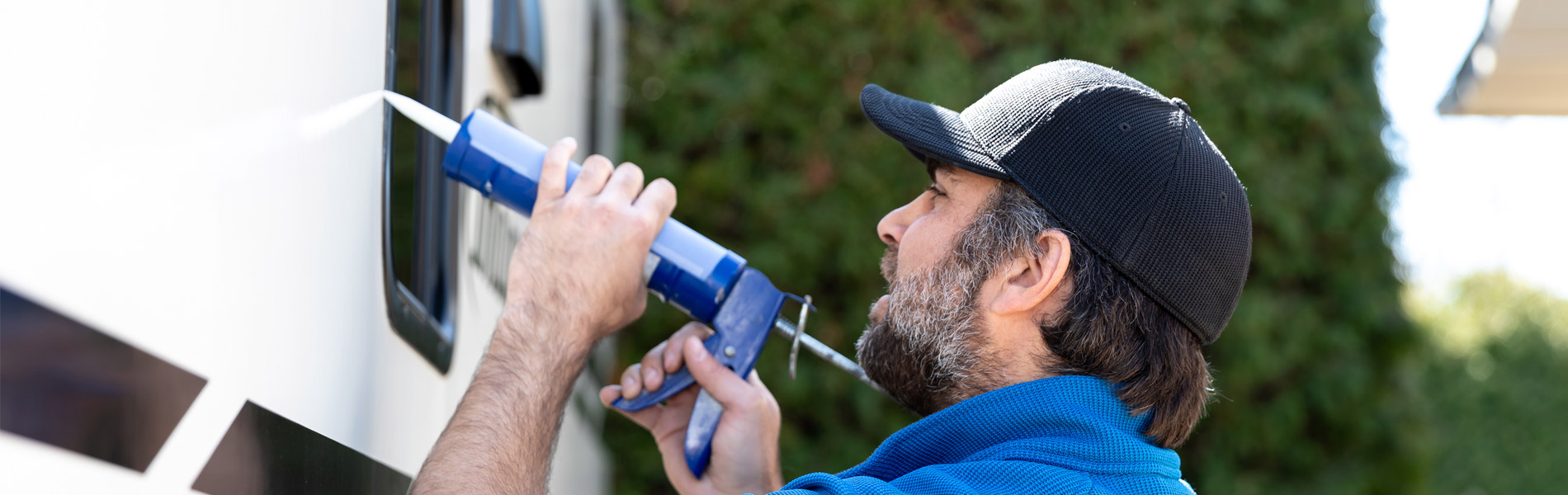
That's a big one, where the roof meets the front cap, sidewalls. You want a self-leveling lap sealant like you would get with NuFlex or the Dicor self-leveling, 'cause that is gonna ooze down. If you're doing something that's vertical, you want more of a paste or a toothpaste-like s- sealant. And remember that silicone is not generically used on every sealant. Winnebago brings out a sealant chart that has specific components or types of materials used in various places, you know, butyl tape underneath the windows and, and so forth.
So, these you can get, online or at any RV dealership. Just check the sealants between the roof and the sidewall. Once you've washed them, you should have a pretty good idea if they need to be just touched up a little bit. I'm not a big fan of Eternabond. we've talked about it many, many times.
Some people have used it forever. That's great. But when you get it, to me, it's an emergency, type of repair. It is very difficult to get off if you ever need to. Plus, if you are going to, be out in the hot areas of the United States, West Coast, Arizona, California and stuff, that gets brittle, and it cracks.
one other sealant that we've come across, and we did a video on this earlier, it's called RV Roof Magic, and it is a great conditioner for the roof. If your roof's starting to deteriorate, you've got some pinholes, things, you can recoat the entire roof. But if it's in great condition, you don't need to recoat that with the entire thing, but just use it on the seams along the edges up there. I've seen several people that have masked that off, taped it, and just put a, a, a paintbrush load on the, on that corner, and it really helps seal that entire area. Now, what about the sidewall?
You know, one of the things is that most of them have a gel coat on the fiberglass or a full-body paint, a lot of decals on the side. I am a fan of the, RV Safe, Clean because it's not gonna deteriorate anything. The Meguiar's is also as, it, can be used. But the big thing is on the decals, and for years they've been saying, "Do not wax the decals. They need to breathe.
Do not use cleaners on them. It will start to take away the, casing on the front of them." And I recently talked with the technician from Sharpline, who is one of the major suppliers of decals out in the market, and they said that they have been testing this product called ReJex, and it is extending the life of those decals by twice as much. Now, normally, you're gonna see there's two different types of decals. There's the three-year decal, and there's the seven-year decal, we, we call them. It's all in the casting and the materials used in them, but that's pretty much the life of them if they're gonna be exposed a lot.
And he's saying that you can double that by using this product. They've had testing out in their labs. They have product outside sitting, baking in the sun, for years, and they said that this is one of the best ones. You can find it on Amazon here. It's something that's really easy to put on, and it's a UV protection that will not deteriorate.
So make sure you look at what material you're trying to clean and condition and to seal and get the proper sealant or the proper cleaning material for your application.
Share tips, start a discussion or ask other students a question. If you have a question for an expert, please click here.
Already a member?
No Responses to “Choosing the Right Cleaning Products for Exterior RV Parts”