
Choosing the Right RV Sealants for Your Vehicle
RV Lifestyle & Repair EditorsRV sealants are essential for keeping out moisture and maintaining a firm bond between the components of your RV. It’s very important for the lifespan of your RV that you complete regular inspections to ensure your RV sealants don’t have any cracks or gaps that might lead to leaks in your unit.
Depending on the type of roof material such as rubber membrane or fiberglass, and the component it is sealed to such as a roof cap or antenna base, it’s extremely important to select the right sealant for each part of your unit. Certain types of RV sealants are best suited for specific jobs, and you should take care to choose the right type. So in this lesson, we introduce a variety of RV sealants, and teach you what products are ideal for which jobs.
Picking the proper sealant for your RV
Some RV manuals come with a chart that lays out which RV sealants satisfy the needs of each part of your unit. However, if you’re still unsure which sealant you should use on a certain component, we recommend avoiding a generic silicone sealant that can cause cracking and leaks in your unit. Instead, Dave Solberg introduces a range of RV sealants that you can utilize on your vehicle to properly adhere to that material for a long time to best keep moisture away.
Dave walks you through each of the most common sealants that are readily available at hardware stores, and explains what they’re best used for. He talks about a handful of RV sealants, including butyl tape for windows and roof and side vents, and discusses the proper way to use this handy, pliable sealant.
Typically, RV owners opt for silicone RV sealants for their ease of application. There are several options from which you can choose, including self-leveling joint sealant for vents, exterior siding and trim sealant that expands and shrinks to accommodate temperature changes, as well as thermoplastic sealant. Remember, it’s important that you don’t just settle for any generic sealant, but rather find the right sealant for the job required. Do your homework and, as always, consult the manual if you get stuck!
Although I'm a big fan of EternaBond and silicone to seal a lot of things, there are specific sealants that are called out for areas on your RV. Now, most manufacturers will put a sealant chart together or have a call-out of recommended products that they use on their vehicles. Now, we obtained this chart from Winnebago Industries. It's one of their sealant charts. It's right online.
You can get it on the website, go into your model, year and find out the specific style. And you'll see here where we've got, the first thing that's called out is what we call a butyl tape. Now, this is used around the windows, frames, also up in underneath the vents on the top. And it's just kind of a puddy type sticky on both sides. You can see here it's just kind of pulls off almost like a gum basically.
And that just is put between the frame and the wall. And once that's tightened down then that's gonna squish and create a watertight seal. And we simply will go around it, trim off the excess piece. You really don't need anything else with that. Now, some manufacturers will do what we call a cap seal on some of the windows on the side.
Really all the cap seal is gonna do is collect dust and it's gonna get dirty and you're gonna have to clean it. If you use a good butyl tape like this, you won't have to do any more to that. Next, we have this. This is a thermoplastic sealant and it's just designed to be able to take some heat ratings. Now, there are different colors available.
You may need to get this in white or a match, a paint color in here and you'll see that called out on the Winnebago guide. The next one I have is a Manus Plus and this is a high performant elastomeric. And what that means is it's gonna be able to expand and contract and move quite a bit. You'll see the call-out for this on that chart. Now this, even though it says a silicone, this is a specific type of a silicone.
It is a sealant silicone, what have we got here, self leveling. Now what that means is once you put it on, you know, a typical silicone is just gonna go on and stay in a bead and you have to push it down and get it into the crevice with your fingers or some type of a tool. What this will do is, as I put this down it will actually level out. So, I'm gonna see this used a lot on the outside tops, specifically around vents, around any covers in the top. So it'll just kind of lay itself flat and seal that whole area out.
And again, I can get this in a variety of different colors to match. If I've got a beige top, if I got a white top, so forth. And then the last one we have here, this silicone is an exterior siding and trim silicone. And it's also designed to expand and contract. When you get cold mornings and hot afternoons those materials have a tendency to move a little bit.
So you want something that isn't gonna harden and crack. I can also, again, this one's clear and I can get it in a variety of different colors to match those trim pieces where I may have a painted basement or bottom quarter. I may have the floor level has got some type of a trim. If I put a white on there and I've got a dark brown or beige or whatever. So each model year is gonna have something specifically called out for those.
So, instead of just using a generic silicone or EternaBond, which is a good product as well but make sure you look at the sealant charts, get the right product for the right place on your RV and you'll keep moisture penetration out.
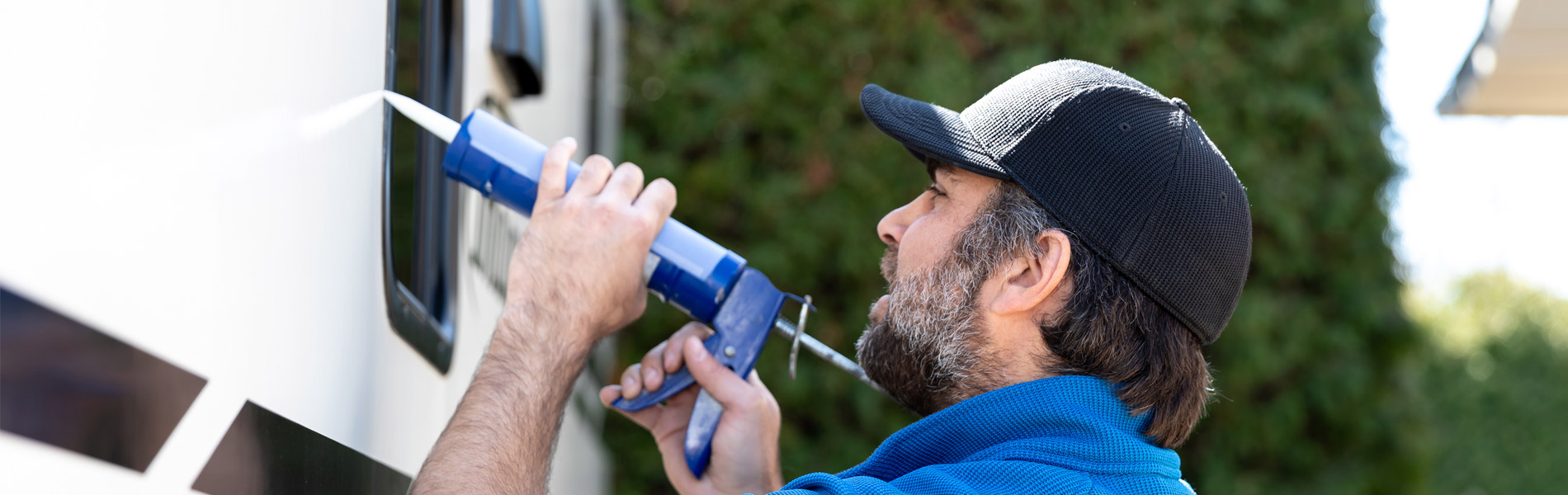
There are many good sealants out there to use other than silicone. As a contractor I have found over the years that the only time to use pure silicone is if you will never have to put anything over it again. We have used it in the past as a bond breaker between the substrate and a urethane caulk because nothing will stick to it even another coat of silicone. It's easy to use but you may pay for it later.